The Trap of Organizing Ideas Too Early

Planelo Team
We have a natural instinct to tidy up. When we see a pile of clothes, we fold them. When we see a cluttered inbox, we archive. In most areas of life, this inst…
We have a natural instinct to tidy up. When we see a pile of clothes, we fold them. When we see a cluttered inbox, we archive. In most areas of life, this instinct serves us well. But when it comes to the creative process, this "tidying reflex" can be a silent killer. I’ve lost more great ideas to premature organization than I have to simple forgetfulness.
The problem is that we often mistake "organizing" for "doing." We spend an hour setting up a beautiful dashboard for a new project, and we feel a rush of accomplishment. But we haven't actually moved the needle. We’ve just rearranged the furniture in a house we haven't built yet. This is why organizing ideas too early is one of the most common productivity traps founders and creators fall into.
The real problem: Deciding before knowing
The core issue is that at the beginning of an idea’s life, you don't actually know what it is yet. An idea is a seed. You don't know if it will become a tree, a flower, or a weed. When you force that seed into a specific category or project folder immediately, you are making a commitment based on incomplete information.
Most tools encourage this by asking for a title, a project, and a status before you’ve even written the first sentence. They force you to define the boundaries of a thought before the thought has finished forming. This premature definition limits the potential of the idea. You stop seeing it for what it could be and start seeing it only through the lens of the box you’ve put it in.
Why this happens: The lure of "Productivity Theater"
We organize early because it feels safe. Starting a project is hard. Writing a first draft is vulnerable. It involves uncertainty and the risk of failure. Organizing, on the other hand, is easy. It has clear rules and immediate visual rewards.
This is what I call "Productivity Theater." We are performing the actions of a productive person without producing the results. The industry rewards this with apps that feature endless customization, complex databases, and "perfect" templates. We get addicted to the setup. We spend our best energy building the system, leaving nothing left for the actual work. We’ve been conditioned to believe that
What works better: The "Incubation Pile"
What works better is allowing for a period of "fertile chaos." Instead of organizing, we should be incubating. An alternative mindset is to treat your ideas like a rough draft that never has to be shown to anyone.
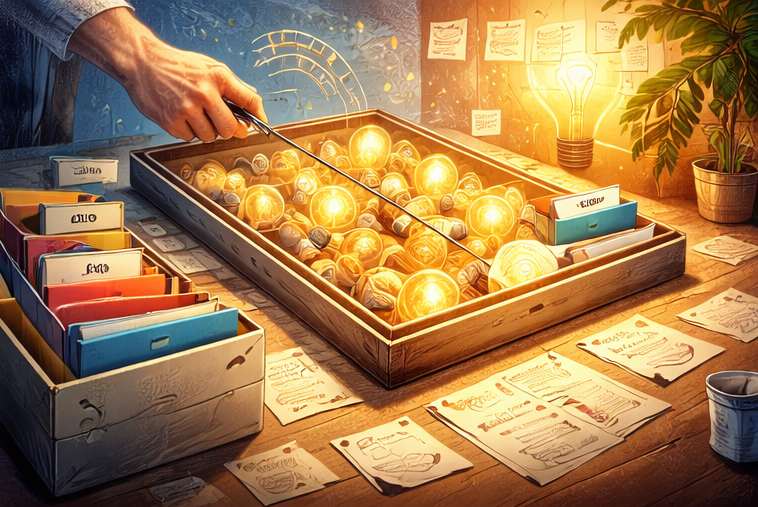
Instead of a project management board, think of an "incubation pile." This is a place where ideas can sit, mingle, and evolve without the pressure of a deadline or a category. Practical examples of this include keeping a simple "long-form" scratchpad or a single digital "dump" file. The goal is to keep the friction of entry at zero. You only organize when the weight of the ideas becomes so heavy that the structure becomes a necessity for movement, not a requirement for entry.
How I approach this (founder POV)
In the early days of Planelo, I found myself spending hours tweaking the "Roadmap" and the "Feature Backlog" before I had even written the core code for the idea capture engine. I was organizing a product that didn't exist yet. I realized I was using organization as a way to avoid the hard engineering problems I was afraid of.
I had to force myself to stop. I deleted my complex project boards and went back to a simple, flat list of thoughts. I told myself: "I am not allowed to create a folder for this until I have five pages of notes about it." This felt "unproductive" at first, but it led to a massive breakthrough. By not organizing too early, I allowed the features to emerge naturally from my actual needs, rather than from a pre-planned structure. Planelo itself was born from this "messy" phase—it’s designed to be the place where you can be unorganized until you’re ready not to be.
Practical takeaway
If you’re prone to over-organizing, try these rules to keep yourself in "creator mode" longer:
The 5-Note Rule: Do not create a new folder, tag, or project board until you have at least 5 distinct notes that belong there.
The "Draft" Label: Label everything as a "Draft" or "Raw" by default. This lowers the psychological stakes of making it look perfect.
Weekly Synthesis: Instead of organizing daily, set aside 30 minutes on Fridays to look at your "pile" and see what patterns have emerged.
Focus on the Next Action: Instead of asking "Where does this go?", ask "What is the very next step I can take on this idea?"
Conclusion
Organization is a great servant but a terrible master. When we use it to support our work, it’s invaluable. When we use it to avoid our work, it’s a trap. The next time you feel the urge to spend an afternoon perfecting your digital filing system, stop and ask yourself: am I building a foundation, or am I just avoiding the work? Sometimes, the most productive thing you can do is leave the mess exactly as it is and just keep creating.