The Missing Layer in Your Idea to Project Workflow
Planelo Team
We’ve all experienced that rush of adrenaline when a new, exciting idea hits us. In that moment, everything feels possible. We quickly jot down a note, maybe a…
We’ve all experienced that rush of adrenaline when a new, exciting idea hits us. In that moment, everything feels possible. We quickly jot down a note, maybe a few bullet points, and then—if we’re feeling particularly ambitious—we move it straight into our task manager. We create a project, set a deadline, and start assigning tasks to ourselves. But then, Monday morning rolls around, we look at that project, and we feel... nothing. Or worse, we feel a strange sense of resistance.
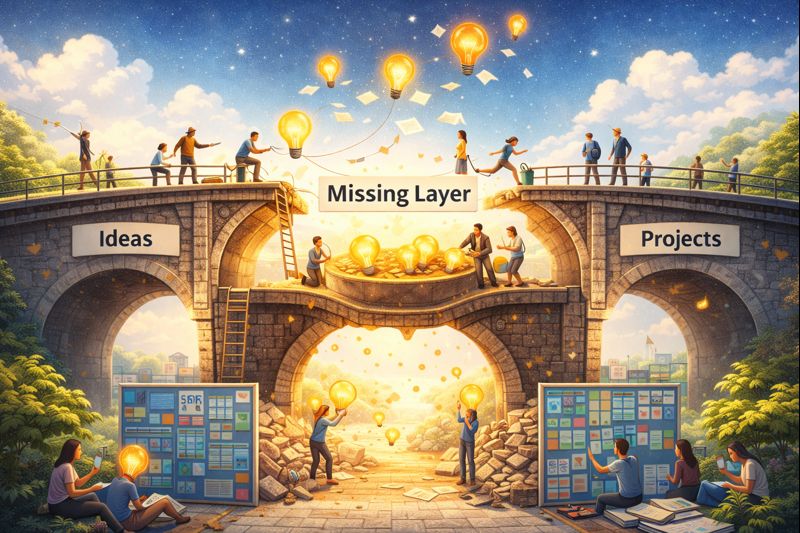
The idea that felt so alive on Friday feels cold and daunting on Monday. Why? Because there is a massive gap between a raw thought and a structured project. This is the "execution gap," and most of us are missing the middle layer in our idea to project workflow. We try to jump from a spark to a fire without any kind of kindling, and then we wonder why the flame keeps going out.
The real problem: Notes are not tasks
The core issue is a category error. We treat a raw note as if it were a task. A task is a concrete action, like "Email the designer about the logo." An idea, however, is a messy, unformed potential. When you put an unformed idea directly into a task manager, you are asking yourself to execute on something you haven't fully understood yet.
Most tools get this wrong by forcing a binary choice: either it’s a note in your "Second Brain" or it’s a project in your "Task Manager." But what about the space in between? What about the phase where an idea is too big for a single note but too vague for a project plan? By skipping this middle layer, we create a sense of overwhelm. We aren't failing at productivity; we are failing at the development of our thoughts. We are trying to
Why this happens: The "Second Brain" clutter
The industry has spent the last few years obsessed with the concept of the "Second Brain." We’ve been told to capture everything—every quote, every link, every random thought. And we do. We have thousands of notes. But for many of us, the Second Brain has become a digital hoard. It’s where ideas go to be stored, not where they go to be developed.
This happens because most knowledge systems are designed for collection, not for action. They prioritize the "storage" of information over the "flow" of work. We’ve been led to believe that if we just collect enough data, a project will magically emerge. But data doesn't build products; decisions do. Without a deliberate workflow to move an idea through a development phase, our notes just become a weight that slows us down.
What works better: The "Development Phase"
What works better is recognizing that an idea needs a period of "cooking." Before a thought becomes a project, it needs to go through a middle layer where you explore its edges. This is where you ask: "What is the core of this?", "Who is this for?", and "What is the smallest version of this I can build?"
An alternative mindset is to view your workflow as a funnel. At the top, you have high-volume, low-friction capture. At the bottom, you have focused project execution. But the middle—the neck of the funnel—is where you filter and refine. This middle layer shouldn't be about organization; it should be about clarity. You aren't filing the idea away; you are wrestling with it until it’s simple enough to act on.
How I approach this (founder POV)
Building Planelo was my attempt to build this missing layer for myself. I realized that my task manager was full of "projects" that were actually just vague ideas I was too scared to delete. Every time I opened my app, I was met with a wall of guilt.
I needed a space where I could develop an idea without the pressure of a "To-Do" list. I started treating my workspace as a laboratory rather than a library. In Planelo, I created a flow that allows me to keep an idea in a "fluid" state for as long as I need. I don't move it to my project list until I can clearly define the first three actions. This single change in my idea to project workflow has reduced my work-related anxiety significantly. I no longer feel like I’m failing at my projects; I feel like I’m finally giving my ideas the time they need to grow.
Practical takeaway
If you feel stuck between your notes and your projects, try adding these "incubation" steps to your routine:
The 24-Hour Rule: Never turn a note into a project the same day you capture it. Let it sit. If it still feels exciting tomorrow, it’s worth a second look.
The Clarity Prompt: Before creating a project, write one paragraph explaining why this idea matters. If you can't write that paragraph, the idea isn't ready.
The "Three Action" Test: An idea only becomes a project when you can name the first three physical steps required to start it.
Scheduled Synthesis: Once a week, pick one "big idea" from your notes and spend 20 minutes expanding on it. Don't organize it—just think on paper.
Conclusion
We don't need more notes, and we don't necessarily need more projects. What we need is a better way to bridge the two. The missing layer in our creative process is the space where we allow ourselves to be messy, curious, and experimental. When you stop rushing to "finish" an idea and start focusing on "developing" it, you’ll find that the transition to a real project happens naturally. Respect the middle layer, and your ideas will finally have the foundation they need to succeed.