The Biggest Startup Mistakes I Made Before My Product Launch
Planelo Team
There is a specific kind of tunnel vision that sets in when you are building something alone. You spend weeks, then months, staring at the same pixels and the…
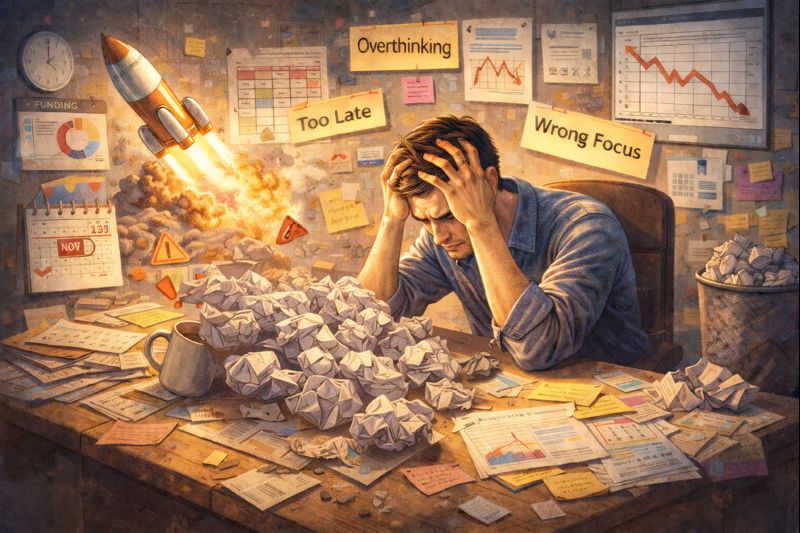
There is a specific kind of tunnel vision that sets in when you are building something alone. You spend weeks, then months, staring at the same pixels and the same lines of code. Your world shrinks down to a Trello board and a local host URL. For a long time, I thought this intense focus was my superpower. I believed that by obsessing over every tiny detail, I was ensuring success. I was wrong.
In reality, I was making classic startup mistakes that almost cost me the entire project. I was so busy "building" that I forgot who I was building for. I was treating my product like a secret that needed to be protected until it was perfect, rather than a solution that needed to be tested. Looking back at the months leading up to the launch of Planelo, I can see now that my biggest errors weren't technical—they were psychological.
The real problem: Building in a vacuum
The most dangerous thing a solo founder can do is build in total isolation. When you don't show your work to anyone, you aren't just protecting your idea; you are protecting your ego. By staying in "stealth mode," you avoid the painful possibility that your idea might not be as brilliant as you think it is.
Most people struggle with this because they think a "launch" is a single event where the world judges your final product. Because of this, we wait until we think we have everything right. We add one more feature, tweak one more color, and write one more line of documentation. But every day you spend building without feedback is a day you might be moving in the completely wrong direction. I previously shared some of the broader
Why this happens: The perfectionism trap
Why do we do this? It usually comes down to a fear of being "found out." As a founder, your product feels like a direct reflection of your intelligence and worth. If the product is messy, we feel like we are messy. Industry patterns reinforce this by highlighting "overnight successes" that seem to have appeared out of nowhere, fully formed and perfect.
We’ve been conditioned to believe that we need to compete with giant, VC-funded teams from day one. We see complex apps with hundreds of features and think that is the baseline. This leads to "feature creep"—the belief that your app isn't ready because it doesn't do "X" yet. In my case, I was so worried about Planelo being "too simple" that I almost ruined the very simplicity that makes it valuable. We often forget that
What works better: Early and ugly validation
What works better is the "early and ugly" approach. It’s the realization that a rough solution to a real problem is infinitely more valuable than a perfect solution to a problem nobody has. An alternative mindset is to view your early users as partners in the building process, not as a jury.
Instead of waiting for a "Grand Opening," try to get 10 people to use your buggy, unfinished prototype. Their confusion will tell you more about your product than 100 hours of solo brainstorming ever could. Practical examples of this include "Building in Public" or simply sending a raw Loom video of your progress to a few friends in the industry. The goal is to break the vacuum as soon as possible. You want to be wrong early, so you can be right sooner.
How I approach this (founder POV)
If I could go back and talk to myself six months before the Planelo launch, I’d tell myself to stop coding and start talking. I spent nearly three months building a complex categorization engine that I eventually deleted because, once real people started using the app, I realized they didn't want to categorize—they wanted to think.
I had made the mistake of assuming I knew what the "perfect" idea management tool looked like. I was building for a version of myself that didn't exist. Now, my philosophy has shifted completely. I try to ship the smallest possible version of any new idea. I mention Planelo to people much earlier now, even when it’s just a sketch on a napkin. I’ve realized that my job isn't to be a visionary who gets it right the first time; it’s to be a listener who iterates fast enough to get it right eventually.
Practical takeaway
If you are currently in the "pre-launch" phase, avoid these common traps:
The "One More Feature" Rule: If you catch yourself saying "I just need to add this one thing before I show it," stop. Show it now.
Talk to Five Strangers: Find five people who fit your target audience and show them your landing page or prototype. Don't explain it—just watch them use it.
Define Your "V0": What is the absolute bare minimum your app needs to do to solve the core problem? Delete everything else from your launch backlog.
Embrace the "Embarrassment": If you aren't at least a little bit embarrassed by your first version, you launched too late.
Conclusion
Mistakes are inevitable, but building in a vacuum is optional. The biggest startup mistakes aren't the ones that break your code; they are the ones that keep you from shipping. Your product will never be perfect, and that’s okay. The world doesn't need perfect products; it needs tools that work and founders who are willing to listen. Break the silence, show your work, and let the real building begin.