Ideas Need Space Over Structure for Better Idea First Thinking

Planelo Team
I spent years believing that if my life felt chaotic, it was because I didn’t have enough folders. I bought into the productivity gospel that says every piece…
I spent years believing that if my life felt chaotic, it was because I didn’t have enough folders. I bought into the productivity gospel that says every piece of information has a specific place where it belongs. My digital workspace was a masterpiece of nested hierarchies. I had folders for "Research," subfolders for "2024 Projects," and tags for every possible context. But a strange thing happened: the more structured my environment became, the fewer original ideas I actually had.
The problem with a perfectly organized system is that it demands a decision before it allows a thought. When you have a spark of something new, a structured system asks: "Where does this go?" and "How should this be labeled?" In that split second of administrative friction, the fragile essence of a new idea often evaporates. I’ve come to realize that for true idea first thinking, we don't need better structures; we need more space.
The real problem: The rigid cage of organization
Most people struggle with their creative output not because they are unorganized, but because they are over-organized too soon. We’ve been taught to treat our digital notes like a physical filing cabinet. In a filing cabinet, an item can only be in one place at a time. It is static.
Most tools get this wrong by forcing you to categorize an idea the moment you capture it. This creates a psychological barrier. If you aren't sure where an idea fits, you might hesitate to write it down at all. This is why
Why this happens: The fear of losing control
We cling to structure because we are afraid. We are afraid of the "void" of an empty page or a messy list. We think that if we don't categorize an idea immediately, we will lose it forever in a sea of digital noise. Industry patterns reinforce this by selling us "all-in-one" workspaces that promise to solve our chaos with more features.
But psychology tells us that creativity thrives on "associative thinking"—the ability of the brain to connect two seemingly unrelated dots. Rigid structures prevent this. When ideas are locked in separate folder-cells, they can’t "bump into each other." We’ve traded the potential for serendipity for the illusion of control.
What works better: Spatial thinking
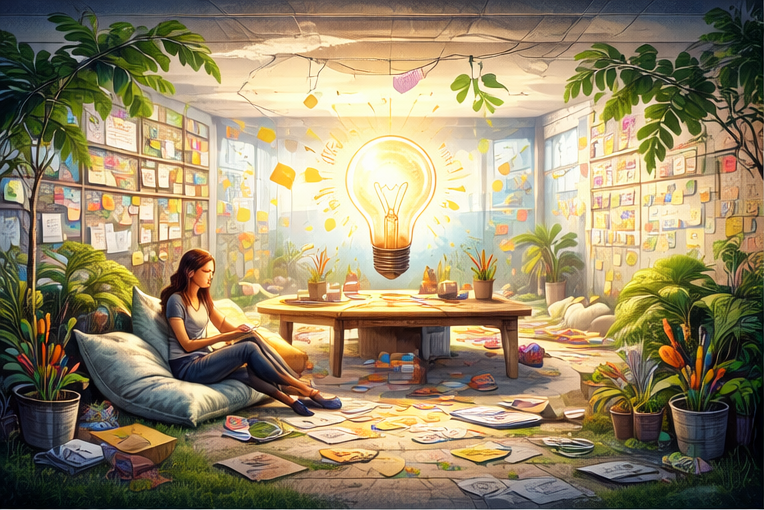
What works better is a "low-friction" environment. Imagine a physical desk. When you are working on something exciting, you don't keep everything in closed drawers. You spread things out. You see the connections between a book, a sketch, and a handwritten note. This is spatial thinking.
An alternative mindset is to allow ideas to exist in a "flat" or "fluid" state for as long as possible. Don't worry about where it lives. Focus on making it visible. Use tools that allow for a "pile" of thoughts rather than a "grid" of folders. When you give your ideas space to breathe, you’ll find that they naturally start to cluster together without you having to force them into a hierarchy.
How I approach this (founder POV)
When I started building Planelo, I made a conscious decision to move away from the "folder-first" mentality. I had reached a point where I was spending more time moving notes between folders than actually developing the projects those notes were meant to support.
I realized that my best work happened when I felt I had "permission to be messy." In Planelo, I wanted to create that same feeling. It’s about creating a buffer zone where an idea can just be an idea before it has to become a "task" or a "project." I stopped asking "Where does this belong?" and started asking "What does this spark?" By removing the structural requirements, I found that I captured 50% more thoughts than I did in my previous, more "powerful" systems.
Practical takeaway
If you feel suffocated by your current digital setup, try these steps to reclaim your creative space:
The "Inbox" Experiment: For one week, put every single note, link, and thought into one single place. No folders, no tags. Just a list.
Visual Review: Instead of looking at a list of filenames, try to see your notes as a canvas. Which ideas seem to gravitate toward each other?
Delayed Categorization: Only move an idea into a "project" or "folder" once it has reached a critical mass of 3–5 related notes.
Embrace the Mess: Accept that the early stage of any project is naturally chaotic. If it feels too tidy, you’re probably not exploring enough.
Conclusion
Structure is a tool for execution, but space is the requirement for creation. If you find yourself struggling to innovate or feel "stuck" in your current workflow, the answer probably isn't a more complex system. It’s likely that you need to tear down some of the walls you’ve built around your thoughts. Give your mind the room it needs to wander, and you’ll be surprised at where it leads you.